Rule No. 1: Stand Up Straight with Your Shoulders Back
Societies are hierarchical. There are people at the top, and others at the bottom. Regardless of how much we wish this weren’t true, and wish even harder for an egalitarian society. There are still higher rungs and lower ones. And it almost seems like most of our life is trying to get from the bottom up. Even if not the highest top, but just up.
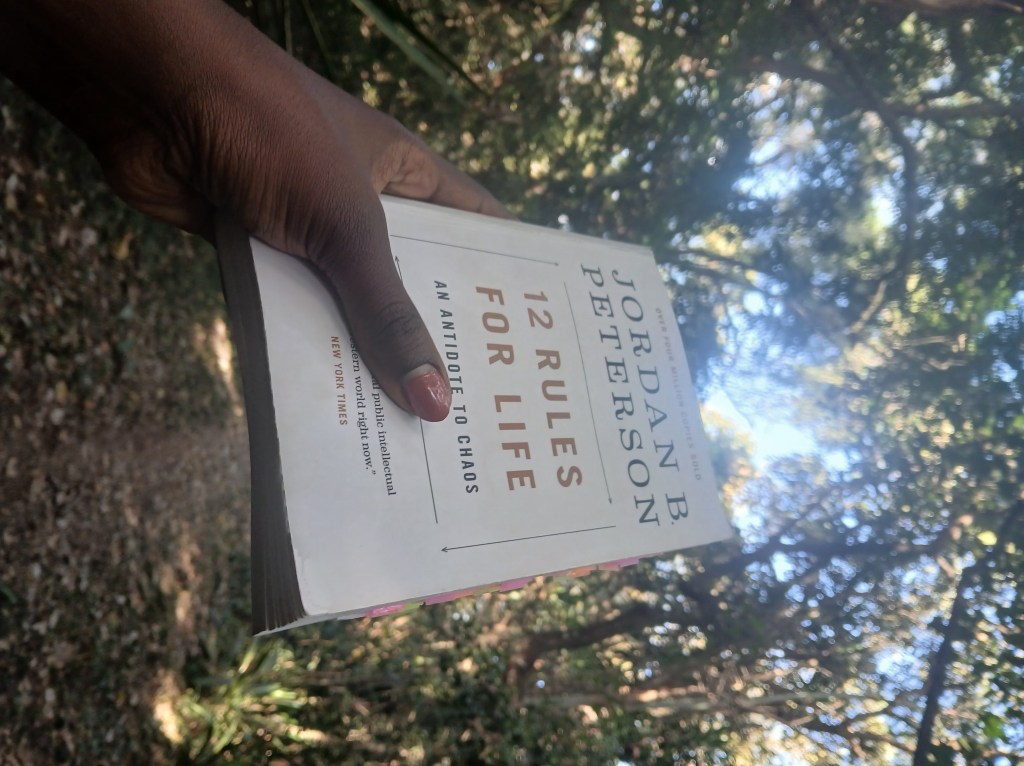
According to this book, this is an inbuilt feature. Something that our brains come pre-installed with. Just like wrens who sing to mark territory, and lobsters and chicken. And literally almost every other animal we know.
We are territorial. But there isn’t enough space at the top for everyone. The animals fight for the space. We do, too in our own ways. And we also assign each other ‘levels’ on the hierarchy. We are also assigned levels and are treated in accordance with our level.
I have seen a meme severally that some people only ask what you do so they can decide the amount of respect to give you.
Some of the level on this hierarchy might be earned – career, fitness, hobbies. While some of it is just inherited. Or just sheer luck. Like good looks, personality and charm.
Does this mean, then, that there will always be people at the bottom? And if the cards are already cast against you, is there really a need to try to get to the top?
We may be at the bottom due to no doing of our own. Or it may just be that we are a collection of bad habits. Whichever the case, we need to strive to move from the bottom. Because nothing good happens there. You settle for less, you’re always hyper-vigilant and ready for a fight—because you think everyone is out to get you. And last but not least, not much of the good stuff gets to the bottom.
How do we do that?
You know how we said that we walk around assigning levels to each other? Apparently, we also move around trying to take note of what level we have been assigned and then we act according to that assigned level. And the cycle continues. This as a result of feedback mechanisms. And in this particular case, positive feedback mechanisms.
In technical terms, a positive feedback loop doesn’t mean “good”—it means self-reinforcing. It’s like microphone feedback when it gets too close to a speaker: a tiny noise goes into the mic, comes out louder through the speaker, re-enters the mic, and amplifies until it’s a deafening screech. The output becomes the new input, compounding the effect every single cycle.
One of the examples used is in a case of depression. Where one is sad and depressed, so they stay home and keep away from people, and end up feeling even more sad and depressed. The signal feeds itself.
In the case of the signals that we’re sending out, if we walk around slouching and defeated, we are treated as such.
“Some of the positive feedback loops instantiated by body language can occur beyond the private confines of subjective experience, in the social space you share with other people. If your posture is poor, for example – if looking small and ineffectual (protected, in theory, against attacks from behind)—then you will feel small, defeated and ineffectual. The reactions of others will amplify that. People, like lobsters, size each other up, partly in consequence of stance. If you present yourself as defeated, then people will react to you as if you are losing. If you start to straighten up, then people will look at and treat you differently.”
We could wish and hope for alternative ways of living. Wish that things were different. But they aren’t. Not yet, at least.
In the meantime, though, we can take up space. And if we don’t feel much up to it for one reason or another, we can fake it, till we make it.
Because these signals are not just outward to other people and physical. They are psychological, too. You are not only signalling to other people. You are communicating to yourself the kind of person you are. The confident one. The one who owns up to their desires like they deserve them, too. Because you do. You step forward and take your place in the dominance hierarchy, and occupy your territory, manifesting your willingness to defend, expand and transform it.
“To stand up straight with your shoulders back is to accept the terrible responsibility of life, with eyes wide open. It means deciding to voluntarily transform the chaos of potential into the realities of habitable order.”
That’s the challenge here. Send signals of the person you want to, or are trying to be. Of the rung in the dominance hierarchy that you desire to be. People, including yourself, will start to assume that you are competent. Then the positive responses you receive will embolden you and you will become less anxious. And it will increase the probability that good things will happen to you—it will also make those good things feel better when they do happen.
“…And then you will embark on the voyage of your life, let your light shine, so to speak, on the heavenly hill, and pursue your rightful destiny.”




Leave a Reply